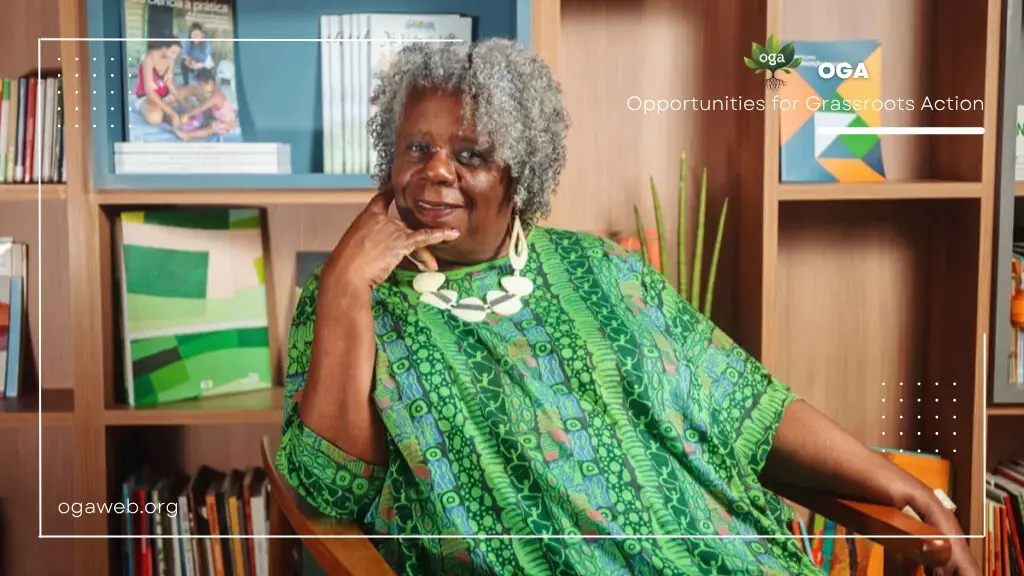
Maria da Conceição Evaristo de Britowas born in 1946 in Belo Horizonte, Minas Gerais, and grew up in a favela community, one of nine children raised by her mother. Like most of the women in her family, she worked as a domestic worker before finishing her secondary education at the Instituto de Educação de Minas Gerais in 1971.
That same year, she moved to Rio de Janeiro to study Letras at the Universidade Federal do Rio de Janeiro (UFRJ). She later earned a master’s degree in Brazilian Literature from PUC-Rio and a doctorate in Comparative Literature from the Universidade Federal Fluminense (UFF), building an academic career on top of a life that had already given her plenty to write about.
Her family’s story continues to shape Brazilian public life: her first cousin, Macaé Evaristo, was appointed Brazil’s Minister of Human Rights and Citizenship in 2024, after a career as a teacher and public official focused on racial equity in education. The two are close enough that people often mistake them for mother and daughter, a mix-up they have joked about publicly. It is a detail worth naming because it says something about the family and the community Conceição Evaristo comes from: not a story of passive hardship, but one of people who kept building, teaching, and leading.
What Escrevivência Actually Means
Evaristoentered the literary scene at 44, publishing in the Cadernos Negros anthology in 1990, a project of the Black writers’ collective Quilombhoje. It was from this body of work that she developed escrevivência, a term that joins escrever (to write) and vivência (lived experience).
She has been careful to distinguish it from autofiction or confessional writing about the self. Escrevivência, in her own framing, is not the writing of one person’s life alone, since that would end with the individual. It carries the collective memory of Black women who came before her, including those who lived and died enslaved, and whose voices were never recorded on their own terms. Writing, in this sense, becomes a way of retaking authorship over a story that colonization and slavery tried to write for Black communities from the outside.
The concept has since moved beyond literary criticism. Researchers in social psychology and the social sciences now use escrevivência as a method for producing knowledge from life stories, particularly those of Black women, rather than only as a literary device.
A Body of Work Recognized Far Beyond Brazil
Evaristo’s novels, short stories, and poetry include titles such as Ponciá Vicêncio, Becos da Memória, and Olhos d’Água, the collection of short stories that won her the Jabuti Prize, one of Brazil’s most prestigious literary awards. Her work has also received the Prêmio Nicolás Guillén and the Troféu Juca Pato, and has been translated into several languages.
Her academic and institutional recognition runs parallel to her literary one. She holds Chair 40 of the Academia Mineira de Letras, and became the first artist, and seventh titleholder overall, to occupy the Cátedra Olavo Setúbal de Arte, Cultura e Ciência, a partnership between the University of São Paulo‘s Institute for Advanced Studies and Itaú Cultural.
Casa Escrevivência: A Home for the Archive
In 2023, Evaristo opened the Casa Escrevivência Conceição Evaristo in Rio de Janeiro’s Pequena África neighborhood, a historic port area tied to the memory of enslaved Africans brought to Brazil. The house holds her personal library, manuscripts, awards, and artifacts, and it doubles as a space for school visits, talks, book launches, and conversation circles centered on Afro-Brazilian and Afro-diasporic literature.
In her own words to Agência Brasil,a book left sitting on a shelf means nothing; it exists only when it circulates and is read.The Casa Escrevivência is her answer to that: turning a private collection into a shared, living resource for research and community learning rather than something locked away for its own preservation.
Watch and Listen
You can follow the Casa Escrevivência‘s work on Instagram at @casaescrevivenciaoficial, and Conceição Evaristo‘s own updates at @conceicaoevaristooficial.
Conceição Evaristo’s Inspiration for OGA Today and Tomorrow
Escrevivência is, at its core, a claim about who has the right to narrate. That claim sits at the center of what we mean by narrative equity at OGA: communities and individuals owning their own stories, knowledge, and solutions, rather than having them translated, summarized, or spoken for by someone else.
Evaristo’s insistence that her writing carries a collective, not just a personal, memory is a useful reminder for anyone working in grassroots spaces. The goal is not to speak on behalf of a community. It is to build the conditions, the access, the language, and the platforms, so that a community can speak, write, and be heard in its own voice.
OGA Voices is a platform dedicated to amplifying the voices that matter, those that challenge established narratives and open space for more just and honest futures. Conceição Evaristobelongs firmly among them. Through the concept she calls escrevivência, she turned the lived experience of Black Brazilian women, long spoken about by others, into literature written and authored by themselves. Her work is a reminder that narrative equity starts with a simple, radical act: letting people tell their own stories, in their own words.