The Irony of COP30: Indigenous Voices Excluded from “Blue Zone” in Their Own Amazon
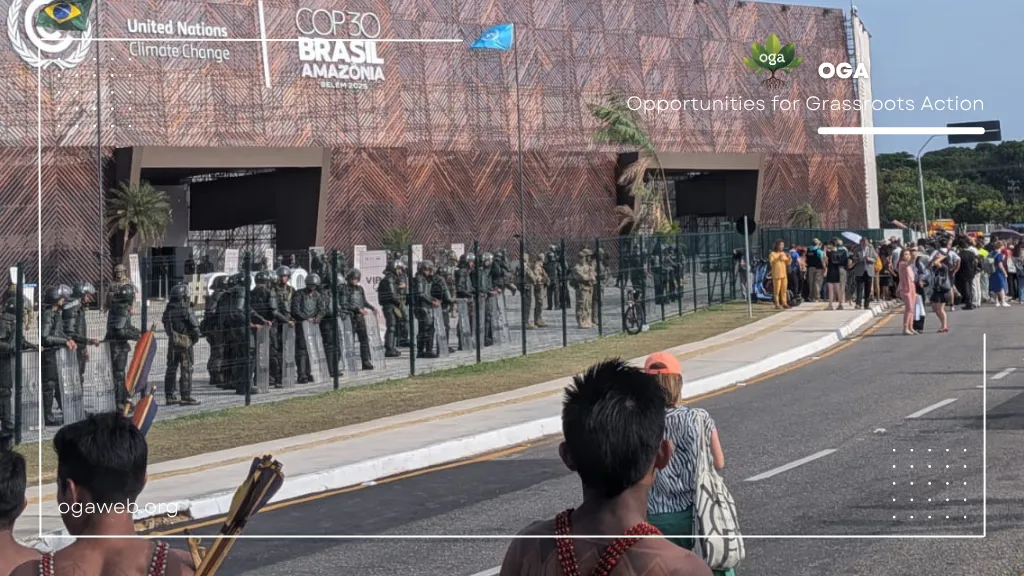
This week at COP30 in Belém — the UN climate summit held in the heart of the Amazon — Indigenous communities are being locked out of the very space where global decisions are being made. It’s not just symbolic: military forces are guarding the restricted “Blue Zone,” while frontline voices are demanding real change.
What’s happening
- Dozens of Indigenous protesters, mainly from the Munduruku people, stormed the COP30 venue and attempted to enter the UN “Blue Zone” — the area for negotiators and high-level delegates.
- Security responded with barricades made of tables, and Brazilian military personnel reinforced the entrance.
- During one standoff, demonstrators formed a human chain, chanting, “No one enters, no one leaves.” This peaceful standoff was reported by organizations like PBS.
- Protesters carried signs saying “Our land is not for sale” and “We can’t eat money” — messages deeply rooted in their fight against deforestation, illegal mining, and agribusiness.
- According to reporting by Climate Change News, only 14% of Brazilian Indigenous representatives at COP30 have access to the Blue Zone — a shocking exclusion considering their central role in protecting the Amazon.
- Simultaneously, the People’s Summit (Cúpula dos Povos), a massive counter-conference expecting over 30,000 participants from 1,300 social movements, is taking place at the Federal University of Pará. It officially opened with a flotilla of over 200 vessels on the river, as highlighted by Greenpeace International, demanding genuine climate justice and rejecting the official negotiations’ “false solutions.” Indigenous leaders are raising their voices there, physically separated from the core UN negotiations.
Why This Is Absurd — and Dangerous
- Greenwashing on Amazon soil: COP30 is being sold as the “Indigenous COP,” but the restrictions show just how far this claim goes.
- Security over justice: The presence of military guards has turned a climate summit into a fortress, prioritizing diplomat access over Indigenous representation.
- Exclusionary power dynamics: When only a small fraction of Indigenous attendees can enter decision-making areas, it perpetuates historical patterns of marginalization.
- Real stakes ignored: These communities aren’t protesting just for visibility — they are on the front lines of deforestation, mining, and extractivist pressures, a plea voiced by Agência Brasil.
What We Can Do / Why We Must Care
- Share their stories: Amplify this protest so the world sees the contradictions of COP30. News outlets like Al Jazeera and The Guardian have covered the standoffs.
- Support Indigenous-led climate justice: Donate, mobilize, or partner with organizations like AMYK, Aldeia Verde, and others working to defend the Amazon.
- Push for real inclusion: COPs must be accountable. If decision-makers are serious about climate justice, Indigenous delegates need full access — not just token representation.
Read More / Sources (Direct Links)
On the Blue Zone Protests and Exclusion
- Al Jazeera: “Our land is not for sale”: Indigenous people protest at COP30
- Climate Change News: 14% of Indigenous Brazilians get access to decision‑making spaces at COP30
- The Guardian: Protesters block main entrance, army called in
- The Guardian: Tussles between protesters and security
- PBS: “No one enters, no one leaves” … peaceful standoff at COP30
- Agência Brasil: Indigenous demand stronger forest protection
On the People’s Summit (Cúpula dos Povos)
- Agência Brasil: COP30: People’s Summit criticizes countries for lack of action
- Greenpeace International: People’s Summit Flotilla with over 200 vessels demand climate justice
- Cúpula dos Povos: Official Site of the People’s Summit
As the struggle for inclusion continues at COP30, OGA stands in unwavering solidarity with the Indigenous peoples of the Amazon. Their exclusion from the very spaces meant to protect their land underscores the urgent need for climate justice that truly centers frontline voices, not just token gestures.