This piece is part of the OGA Voices series, which spotlights activists from the Global Majority whose words and work inspire collective liberation.
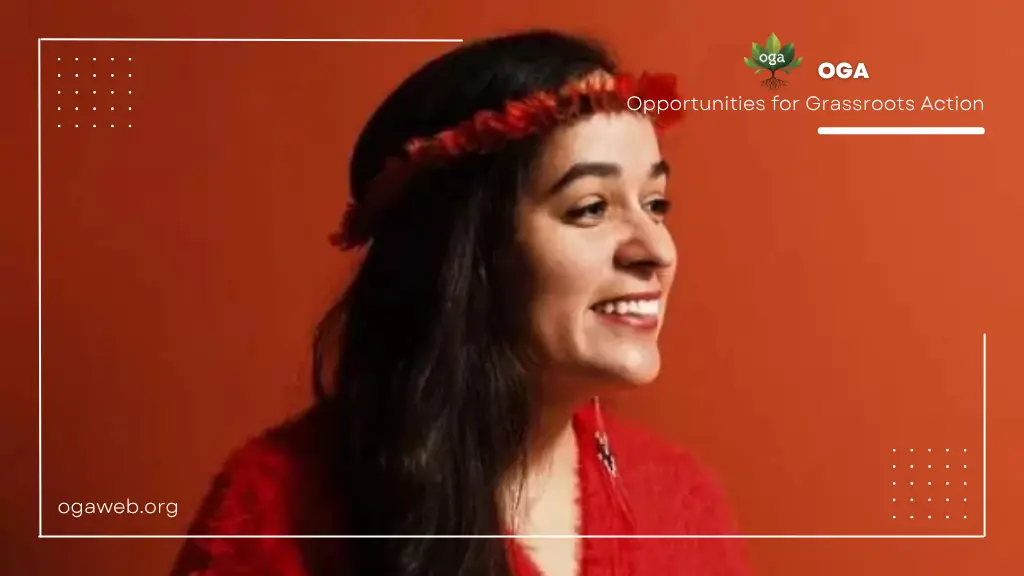
There is a question that Geni Núñez invites us to ask, time and again: What has coloniality done to our capacity to love?
A Guarani indigenous psychologist, writer, and activist, Geni holds a Ph.D. in the Humanities from the Federal University of Santa Catarina and is the author of books such as Decolonizing Affections: Experiments in Other Ways of Loving and Happy for Now: Writings on Other Possible Worlds. She helps us realize that the way we love is not neutral. It bears the mark of a colonial project that taught us that the only true love is monogamous, Christian, and heterosexual.
For Geni, the violence of colonialism did not stop at the borders. It crept into our beds, our hearts, and our ideas of happiness.
What are “monocultures of affection”?
Geni refers to the imposition of a single way of life as monocultures. For her, coloniality operates on at least three emotional fronts:
- The monoculture of affection: monogamy as the only legitimate form of love.
- Monoculture of faith: Christian monotheism as the sole spiritual truth.
- The monoculture of sexuality: monosexism (the idea that you have to choose a side) as the only valid way to desire.
“In these monocultures, only one god would be true, only one love would be legitimate, only one sexuality could be chosen” — Geni Núñez.
It is no coincidence that these three things were imposed together. It is the same system that cleared forests, decimated peoples, and taught us that diversity is a threat, not abundance.
Ethnogenocide: When the Body and Emotional Well-Being Are Attacked Together
In her doctoral research, Geni proposed the concept of ethno(geno)cideto demonstrate that physical extermination cannot be separated from cultural and emotional erasure. There is no genocide without ethnocide.
This means that colonial violence isn’t just about gunfire, starvation, and stolen land. It’s also about unlearning communal love, the shame of polygamy, the fear of polyamory, and the pathologization of jealousy. It’s the loneliness of those who love differently in a world that recognizes only one way of caring.
For Geni, this violence manifests itself in the state, in the police, in obstetrics, and even in our language. And the answer cannot simply be to “include more” in a broken system. It must be anti-racist, feminist, and anti-colonial all at once.
As she wrote in the preface to The Polyamorous Challenge, by Brigitte Vasallo:
“It’s not about focusing on the number alone; there is no intrinsic value in the singular, nor is there any inherent flaw in the plural. What invites us to reflect is the quality of our relationships with others: it has much more to do with the ‘how’ than with the ‘how many’.”
Reforesting the Imagination
Geni’s proposal is not to create a new rule (“everyone has to be non-monogamous”). It is to make room for multiplicity to exist. She speaks of reforesting the imagination: bringing back the idea that we can have meaningful relationships without hierarchy, where friendship isn’t a “second-class” relationship and care doesn’t require possession.
Geni also reminds us that, within the logic of monogamy, only a romantic relationship counts as “true companionship.” A single person would be “alone” even if surrounded by friends and loved ones. This hierarchy of affection subordinates bonds that are fundamental to our survival, especially for women, Black and Indigenous folks, who have always depended on community networks to exist.
For Indigenous peoples, no being is superior to another. Geni invites us to understand that the air we breathe is a companion, the water that quenches our thirst is a friend, and the food that nourishes us is a close friend. If we take this to heart, love ceases to be about possession and becomes shared care.
Why Geni Núñez is an OGA Voice
Geni Núñez is an OGA Voice because she articulates an uncomfortable truth that few people want to face: coloniality hurts our hearts just as much as it hurts our land. And liberation will not come from well-behaved “inclusion,” but from rejecting the false dilemma, from the courage to say that life is multiplicity, and that love can be too.
She reminds us that the world we want to build is not merely political and economic. It is also emotional. And that decolonizing our emotions is, at its core, an exercise in reforesting the imagination: making room for other ways of loving, caring, and existing.
This piece is part of the OGA Voices series. For more reflections on the movements building a different world, explore our ongoing coverage here.
To learn more
- 📖 Decolonizing Affections: Experiments in Other Ways of Loving— Geni Núñez
- 📖 Happy for Now: Writings on Other Possible Worlds — Geni Núñez
- 📖 The Polyamorous Challenge— Brigitte Vasallo (with a foreword by Geni Núñez)
- 🎙️ Interview with Geni Núñez on CBN: Non-monogamy: the other person’s desire is not information about me
Read more on OGA:
- Simone Grace Seol: Reimagining AI, Life, and Abundance Beyond Colonial Frames
- Arundhati Roy: Another World Is Breathing for The Activist Who Refuses Silence
- We’re All Human, and Why That’s Not Enough