Guardiãs do Bem Viver: Yanomami Women in the Amazon Strengthen Their Organization and Open New Paths
A project bringing together Yanomami women from five villages closes its pilot phase with the handover of the Casa das Guardiãs and a photo exhibition.
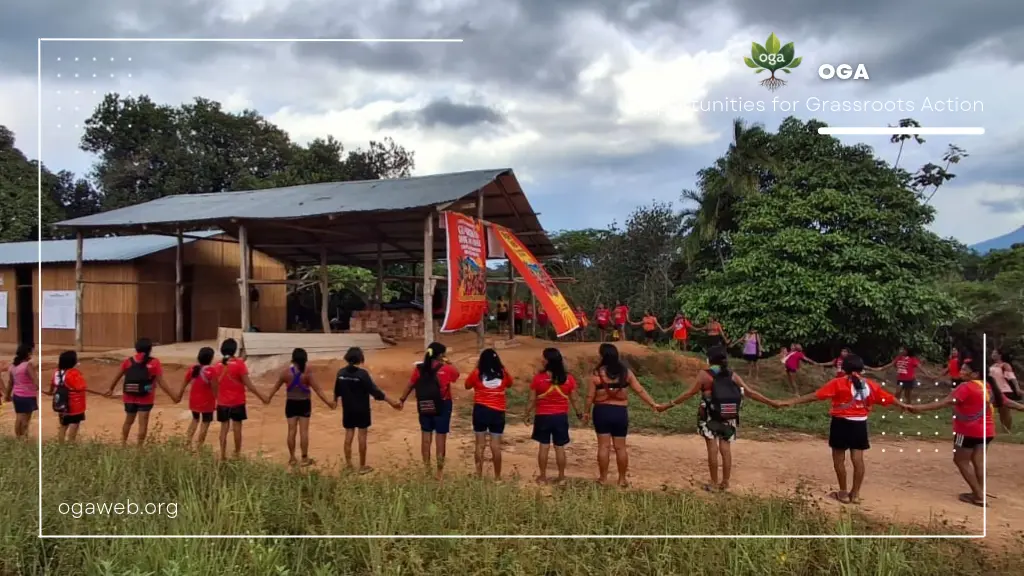
Launched in 2025, the Guardiãs do Bem Viver project grew out of demands raised by Yanomami women during the IV Forum of Yanomami and Yekwana Leaders (2023), held in the Maturacá region of Amazonas. Today, about 150 women from villages along the Cauaburis River take part, among them Maturacá, Ariabú, Palmares, Bela Vista and Auxiliadora, all in Amazonas.
Coordinated by the Instituto Etnoambiental e Multicultural Aldeia Verde (IEMAV), under the leadership of anthropologist and indigenist Cláudia Franco, the project was carried out in partnership with the Federal University of Catalão (UFCAT), the Federal Government and other partners.
What the women built
The first phase of the pilot project, carried out between February and September 2025, focused on strengthening AMYK. It included workshops on associativism, support for organization and document preparation, conversation circles on women’s rights, and training activities for Indigenous communicators.
The work also produced bilingual materials, including booklets on associativism and documentation, and an illustrated publication about AMYK’s history. The women received support materials and took part in regular training and exchange meetings.
In the second phase, between November 2025 and September 2026, the actions moved forward on other fronts:
- Environmental recovery: setting up a seedling nursery for degraded areas and planting a medicinal plant mandala in an agroforestry system in the Palmares village.
- Strengthening the Guardiãs: site preparation and construction of the Casa das Guardiãs (the project headquarters), plus new uniforms and materials for the artisans.
- Women’s rights: conversation circles on the possible reduction of domestic violence and the preparation of a booklet on their rights.
One of the most important results was the greater presence of women in decision-making spaces. Carlinha Yanomami, president of AMYK, took part in meetings, gatherings and seminars with representatives of public institutions. In 2025, she attended the Acampamento Terra Livre in Brasília and COP30 in Belém, where she presented the project. In 2026, the association had a voice at the Yanomami and Ye’kwana Leaders’ Forum, giving government representatives the chance to learn about the reality of Yanomami women in the villages of Amazonas state.
Her journey and her demands have already been featured in several publications. In an interview with UNICEF, Carlinha spoke about her work as an educator and her concern for children’s food in Maturacá. In another report, published by Brasil de Fato, she shared her views on defending women’s rights and the territory. She also spoke about the importance of traditional production and food sovereignty in a publication by the Ministry of Social Development.
Another relevant result concerns the fight against domestic violence. Reports gathered by the team point to a drop in cases of violence against women and girls in Maturacá since the project began. The team links this change to the continued presence in the territory and to conversations about women’s rights.
Culture and traditional knowledge are also at the heart of this journey. UFCAT donated a boat and a 50hp motor, which make it easier for the Guardiãs to travel and to gather perisi, the fiber used in traditional Yanomami basketry, known as wii, xôto and others. These fibers are becoming harder to find, as they grow farther from the villages, and that threatens the practice. The boat is therefore concrete support for artisanal production and for passing this knowledge on across generations.
Meet the Guardiãs
Nine videos produced by OGA bring together testimonies from Gabriela, Gracimar, Carlinha, Elizabete, Josefa, Alexandra, Maria Rosa, Elza and other participants.
The Casa das Guardiãs and the exhibition
On October 29, 2026, the journey of these women was presented in the photo exhibition Temï Përi Mapotima Nohi Rëporemi, at the Federal University of Catalão, in Goiás. The show brings together 28 scenes of everyday life in Maturacá, Ariabú and nearby communities. The photographs were taken by young women from these communities, in a project led and curated by photographer Yuri Alvetti.
On November 3, 2026, the pilot project reached another milestone: the handover of the Casa das Guardiãs, a Yanomami headquarters and a space for meetings and collective activities. The building, the result of collective investment by UFCAT and IEMAV, makes an old dream of Yanomami women come true and is an important achievement for all of them.
New paths
The experience opens possibilities for the initiative to reach other Indigenous territories, respecting the priorities and forms of organization of each people. Conversations are already underway with women’s organizations among the Guajajara, Tremembé, Kayapó, Xikrin and Nambikwara peoples, among others.
With support from IEMAV and OGA, the Guardiãs were also selected for the People Powered Accelerator, an international initiative to strengthen participatory organizations and processes.
OGA walks alongside the Guardiãs do Bem Viver, supporting a journey built by the women themselves. For us, this partnership also means helping their initiatives, knowledge and demands find new connections and opportunities.
Expanding this work depends on new alliances. We are looking for organizations, funders and partners interested in supporting the Guardiãs and walking alongside these Indigenous women.
Get in touch: info@ogaweb.org