OGA Insights is where we bring context to causes that need sustained attention, even after they’ve faded from the headlines. The Rohingya crisis is one of them. You may never have heard of this people, and that’s alright. Much of the world hasn’t either, and that gap in visibility is part of why we’re writing this and OGAexists.
Who are the Rohingya
The Rohingyaare a Muslim ethnic minority who lived for generations in Rakhine State, in western Myanmar. Despite that long history in the region, Myanmar’s government has never recognized them as citizens. In practice, that has made the Rohingya the world’s largest stateless population: people with no nationality recognized anywhere, cut off from the basic protections citizenship guarantees, including healthcare, formal education, freedom of movement, and legal identity. Statelessness isn’t a technicality. It means going through life without a country willing to call you its own. You can read more background on UNICEF’s page on the Rohingya crisis.
2017: the breaking point
In August 2017, a wave of military violence against the Rohingya in Myanmar’s Rakhine State forced over a million people to flee across the border into neighboring Bangladesh. Villages were burned, families were separated, and thousands were killed. The United Nations has since described what happened as genocide.
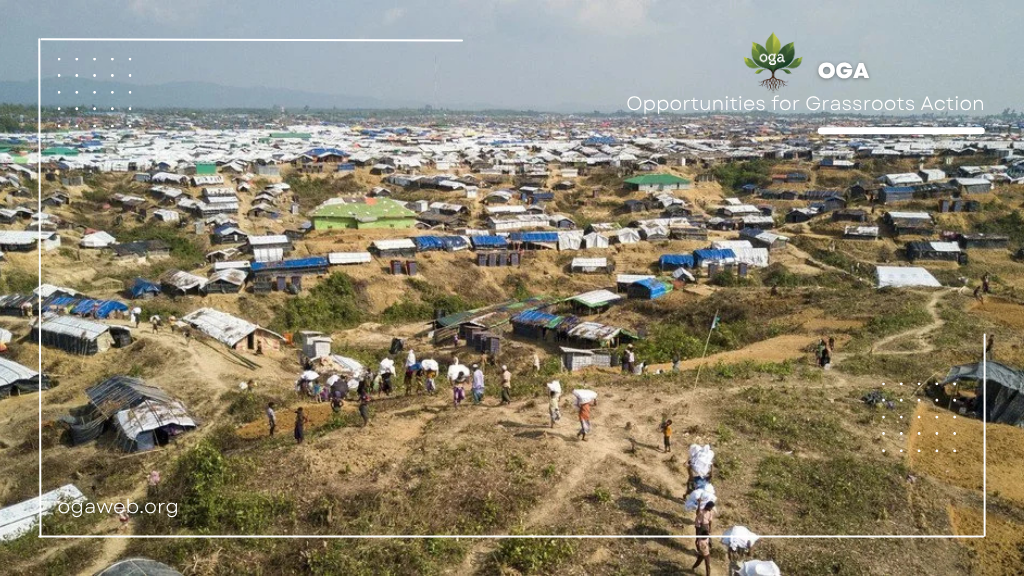
Nine years on, around 1.1 million Rohingya refugees still live in and around Cox’s Bazar, now the largest refugee settlement in the world, according to UNHCR. More than half of them are children. A growing number were born inside the camps and have never set foot anywhere else. For them, statelessness isn’t an event from the past. It’s the only reality they’ve known.
A crisis that didn’t end, it just dragged on
Rohingya refugees are barred from working legally in Bangladesh, which means they depend almost entirely on humanitarian aid. That aid keeps shrinking. According to a recent NPR investigation, funding cuts have pushed food ration values down to as little as seven dollars per person a month under a new tiered system, at a time when chronic child malnutrition in the camps was already a serious concern.
The consequences fall hardest on young people. A report from the International Rescue Committee found that around half a million refugees aged 18 to 24 in Cox’s Bazar have no access to formal work or accredited education. Just 2% of Rohingya parents surveyed said they feel hopeful about their children’s futures, compared to 84% of people in the neighboring host community living under very different conditions. More than 235,000 children aged 5 to 17 are currently out of school entirely.
Physical safety remains precarious too. Fires continue to tear through the densely packed camps, most recently in January 2026, when a blaze in Camp 16 displaced hundreds of families, according to World Vision. And repatriation to Myanmar, floated for years as the eventual solution, remains both distant and unsafe, with little sign of the conditions that would make a safe return possible.
Beyond the numbers
It would be easy to reduce the Rohingya to a list of losses. But that would only tell half the story. Behind the statistics are communities actively organizing: educators running informal schools inside the camps because formal ones aren’t accessible, women leading protection and support networks for survivors of gender-based violence, and young people pursuing languages and trades to build some kind of future, even without the legal right to work.
Statelessness is not an absence of identity. It is the denial of a right that should already be guaranteed. Understanding that distinction matters, because it shapes how the rest of the world responds: with charity that treats people as passive recipients, or with solidarity that recognizes their agency and supports the paths they’re already building.
Why this crosses paths with OGA’s work
In the current cohort of Language for Justice, OGA’s interpreter training / social justice initiative, we have Rohingya participants learning interpretation and translation so they can work in spaces where their own voices, and their community’s, are heard on their own terms. Not as beneficiaries of a project, but as professionals building a path forward, equipped to advocate, translate, and represent their community in rooms they were historically excluded from.
This is what narrative equity looks like in practice. It’s not about telling someone else’s story for them. It’s about making sure the tools, training, and access exist so people can tell it themselves, and be heard.
Amplifying isn’t speaking for others. It’s opening space, offering tools, and stepping aside once the community already knows what it needs to say. Nine years into this crisis, that work is far from finished, and neither is ours.
Sources: UNHCR, UNICEF, IRC, World Vision, End Rohingya Repression, NPR (August 2026)