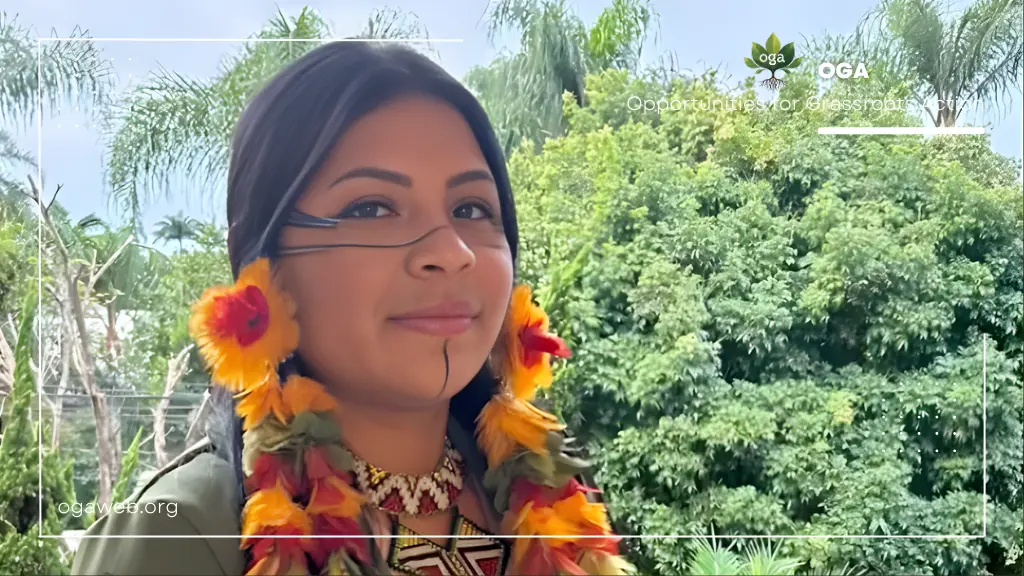
In southern Bahia, where the Atlantic Forest endures amid memories of invasion, reclaiming, and survival, the history of the Pataxó people continues to be written by women. Women who have transformed trauma into territory, silence into a living language, and erasure into presence. Among them is Ludmilla Pataxó, a young Indigenous artist, designer, mother, entrepreneur, and contemporary creator whose journey carries the weight and beauty of a lineage of women who helped rebuild paths for her people.
Ludmilla comes from the Pataxó da Jaqueira Reserve, an indigenous territory officially established in 1998 thanks to the visionary leadership of three Pataxó sisters: Nitynawã, Jandaya, and Nayara. The reserve was established not only as a physical space, but as a political, spiritual, ecological, and cultural project aimed at revitalizing Pataxó identity.
The Jaqueira Reserve and the Pataxó Matriarchy
The history of Jaqueira is, at its core, a history of indigenous matriarchy.
The three sisters grew up listening to their elders talk about a culture that was nearly wiped out by colonial violence, land evictions, and systematic attempts at assimilation. After centuries of persecution and following the trauma of the so-called “Fire of ’51”, the massacre and repression suffered by the Pataxó in 1951, many families were scattered and forced to hide their Indigenous identity in order to survive.
It was in this context that the sisters decided to take the path opposite to that of erasure: to return to the forest, revive the Patxohã language, strengthen their rituals, rebuild the kijemes, and revitalize ancestral songs, dances, paintings, and medicines.
Dona Taquara: 106 Years of Living Pataxó Memory
At the heart of this ancestral continuity is Dona Taquara, Ludmilla Pataxó’s grandmother and one of the community’s great matriarchs.
At 106 years old, Dona Taquara embodies living memory, resilience, and endurance. Her name appears in academic records and historical accounts related to the establishment of the Jaqueira Reserve and the processes of cultural empowerment among the Pataxó people.
Surrounding her, daughters, granddaughters, and children took part in rebuilding community life in Jaqueira. Her presence connects different generations of Indigenous women who have kept the Pataxó culture alive despite profound historical violence.
The name “Jaqueira” also carries ancestral symbolism. According to Pataxó leaders, it stems from the metaphor of a jackfruit tree that fell but sprouted again and bore new fruit. Just like Pataxó culture: violated, but never destroyed.
Ludmilla Pataxó and the new generation of indigenous women entrepreneurs
It is within this ancestral continuity that the work of Ludmilla Pataxó emerges.
Recent research on contemporary indigenous art describes Ludmilla as one of the young Pataxó artists who have been expanding the languages of traditional culture without breaking with their roots.One of the studies on Jaqueira highlights that she rejected the expected artistic path and began developing contemporary clothing and creations inspired by the graphic motifs and narratives of her people, becoming one of the first Pataxó fashion designers of her generation.
Ludmilla represents a new generation of Brazilian Indigenous women: mothers, entrepreneurs, artists, educators, and communicators who bridge the gap between tradition and modernity without losing sight of their roots.
Her art does not merely operate in the aesthetic realm. It conveys a sense of belonging, memory, and resilience.
The works created by Ludmilla tell stories of unity among indigenous peoples, ancestry, territory, and cultural continuity. They are works that navigate the contemporary world without abandoning the collective spirit of tradition.
Contemporary Indigenous Art as Cultural Resistance
Historically, indigenous peoples have often been portrayed through an external, anthropological, or folkloristic lens. The work of young indigenous artists like Ludmilla breaks with this colonial logic.It is not merely a matter of preserving culture, but of building a future based on it.
The experience of the Pataxó da Jaqueira Reserve itself has been studied internationally as an example of decolonial practice. Researchers point out that the community uses tourism, art, and education as ways to reframe the Indigenous narrative and reaffirm its cultural and environmental rights in the face of the historical violence of colonialism.
Discover. Experience. Learn. Listen.Supporting contemporary Indigenous artists isn’t just a trend. It’s about historical redress, redistributing visibility, and strengthening Indigenous community economies.
Indigenous women leaders: Ludmilla Pataxó participated in OGA’s online circle
In April of this year, Ludmilla Pataxóparticipated in the online roundtable for Indigenous Women Leaders organized by OGA, Instituto Aldeia Verde, Guardians of Good Living Project and Indique.
The gathering brought together Indigenous voices committed to regeneration, ancestral memory, women’s leadership, communication, and social justice. Their presence underscored a fundamental point: that contemporary Indigenous struggle takes place not only in physical territories, but also in digital, cultural, and narrative territories.
Today, Indigenous women are leading climate, educational, linguistic, spiritual, and artistic movements in different parts of the world. And in the case of Jaqueira, this has been happening for decades through a model of collective leadership deeply rooted in the women of the community.
The future of Indigenous peoples is already here
There is something deeply symbolic about the fact that a reserve founded by three sisters has shaped generations of young women artists and cultural leaders.
From Grandmother Taquarato the founders of the reserve. From cultural revivals to contemporary studios. From traditional singing circles to international online conversations.
All of this is part of the same continuum.
In a Brazil that still insists on treating indigenous peoples as a thing of the past, stories like that of Ludmilla Pataxó serve as a reminder that indigenous peoples are not mere historical relics. They are the present, a source of creativity, collective intelligence, and a living future.
And perhaps that is exactly what the Jaqueira tree represents. Not just resilience, but cultural renewal.
Sources and references:
• Jaqueira Pataxó Reserve
• Globo Ecologia: Revitalizing Pataxó Culture
• Brazilian Journal of Environmental Education: Jaqueira Pataxó Indigenous School
• ScienceDirect: Decoloniality and Indigenous Tourism in Jaqueira
• ISA: Pataxó Feminism and the Jaqueira Reserve
• Tem Cidades: Revival of Pataxó Culture
• Travel and Tourism: Pataxó Reserve of Jaqueira
• Research on Pataxó resistance and art
• The Pataxó Reserve of Jaqueira: the past and present of traditions
OGA is deeply grateful for the opportunity to share and amplify stories such as that of Ludmilla Pataxó and the women of the Jaqueira Reserve. We recognize this territory as one of the most powerful examples of community-based ecotourism, ancestral education, and ongoing cultural reconstruction in contemporary Brazil, where the forest, the language, and the memory continue to be carefully regenerated by Indigenous hands.
We will continue to follow and delve deeper into the stories of each of the sisters who helped build this project, as well as the matriarch Dona Taquara, aged 106, and leaders such as Juari Pataxó, who sustain this living ecosystem of culture, spirituality, and future. This is just the beginning of a series of narratives that we intend to expand, always with respect, attentiveness, and a commitment to Indigenous peoples and their unique ways of existing and thriving.