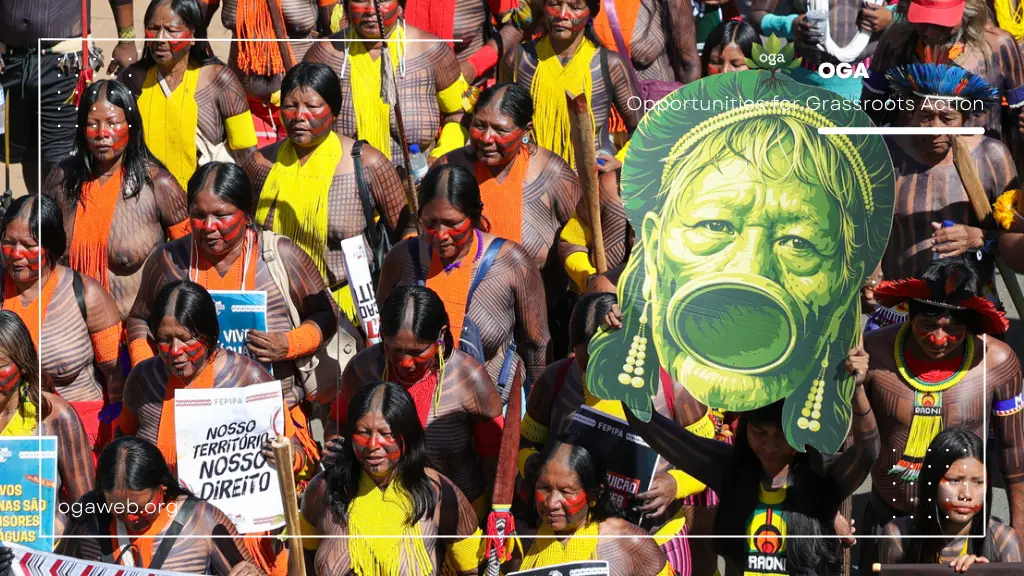
Between April 5 and 11, 2026, Brasília was taken over. Not by tanks or backroom politicians, but by more than 7,000 voices that have never been silenced: Indigenous peoples from all over Brazil gathered for the 22nd edition of the Acampamento Terra Livre (ATL), the largest Indigenous mobilization in Latin America.
They came from every biome, from every state, from some 200 communities. They came wearing war paint, headdresses, and carrying bows, and bearing enquiries. Not to ask. To demand.
This year’s theme is straightforward, and for that very reason it unsettles those who prefer silence: “Our Future Is Not for Sale: We Are the Answer“.
Many people still refer to the ATL as “an ‘Indian’ event [sic].” The term is a colonial misnomer, but it persists among those who disparage the struggle. We do not endorse it. We document it and denounce it.
This issue isn’t just about Indigenous people. It concerns everyone.
At the 2026 ATL, indigenous peoples presented the Brazilian Ministry of Foreign Affairs with a document that every minister, every business leader, and every citizen should be talking about: the “recommendations of the Brazilian indigenous movement for a global roadmap beyond fossil fuels“.
In other words: Brazil’s indigenous peoples are showing the world how to move away from oil, gas, and coal.
The document, submitted by leaders such as Dinamam Tuxá, executive coordinator of the Coalition of Indigenous Peoples of Brazil (APIB), proposes three things:
- An immediate end to the development of new oil, gas, and coal fieldsworldwide.
- Establishment of Fossil Fuel-Free Zones (FFZs) starting with the Amazon.
- A binding global agreement for the phased-out elimination of fossil fuels.
And the key to it all lies in a quote from Dinamam Tuxá:
“There can be no just energy transition without safeguarding our territories. The demarcation and protection of Indigenous Lands are concrete measures for addressing the climate crisis.”
The truth the green market tries to hide: without demarcated land, there is no climate to save. Indigenous peoples protect 80% of the planet’s biodiversity. Protecting their territories is the most effective climate policy there is. It is cheaper and fairer than any carbon offset.
Our partners were there
OGA is not merely supporting this struggle from afar. Our partners and sister projects were on the ground at ATL 2026, taking up space, making their voices heard, and strengthening political coordination.
The Kumirayoma Yanomami Women’s Association (AMYK), led by the tireless Carlinha Yanomami, was present with its ancestral strength. AMYK is the organized voice of Yanomami women in Amazonas, founded to resist aggression and ensure the cultural continuity of the Yanomami peoples. Guided by the spirit of Kumirayoma, the spiritual woman who protects women and the forest, the association carries out essential projects to ensure the autonomy of its female members within their territories.
Also in attendance was the Aldeia Verde Ethno-Environmental and Multicultural Institute (IEMAV), an organization rooted in ancestral wisdom and committed to autonomy for indigenous peoples throughout Brazil. IEMAV works to protect Brazil’s biomes and strengthen ancestral traditions in Abya Yala, the indigenous name for the American continent.
Claudia Franco, an anthropologist and contributor at OGA, was also at the camp. She is a co-facilitator of AMYK’s “Guardians of Good Living” project, alongside President Carlinha Yanomami. It was Claudia who recorded on video the presence of Kayapó women and the Tapirapé people at the ATL 2026 march. Her work with AMYK included the production of a bilingual booklet (Portuguese and Yanomami) that documents the association’s history and knowledge, a living archive that affirms Indigenous epistemologies and records other ways of existing, caring for, and narrating the world. There, knowledge is not extracted. It is cultivated, shared, and protected through a network.
What else is at stake
In addition to the international climate agenda, ATL 2026 reaffirms what has always been the backbone of the indigenous struggle: land demarcation.
Without land, there is no language. Without language, there is no culture. Without culture, there is no people.
The attacks are coming from all sides. From the legislature, where the ruralist caucus holds about 40% of the seats. From the executive branch, which insists on revising land demarcations. From the judiciary, which drags out legal proceedings. And, more recently, from the expansion of oil exploration at the mouth of the Amazon, which directly threatens indigenous territories.
That’s why the ATL exists. That’s why they come from so far away. The struggle isn’t about privilege. It’s about survival.
OGA is a Guarani word. It means family, home. We are not just a platform. We are a home that embraces the struggle of those at the grassroots level, of those who consider the land their territory and memory their tool.
Our brand, our ethos, and our visual identity, created by Indigenous artist Juliana Gomes (Jaguatirika) of the Laklãnõ/Xokleng people, are a daily affirmation: ancestry is technology. And the greatest technology there is is the ability to organize, resist, and occupy.
We support ATL because climate justice and territorial justice are one and the same. We support AMYK, IEMAV, Carlinha Yanomami, and Claudia Franco because they are on the front lines. And OGA amplifies Indigenous voices. Without setting the agenda. Without translating. Without over-explaining.
We also provide support through initiatives such as Language for Justice (LFJ), which builds bridges through language for marginalized communities, and in partnership with DEI Declassified, which highlights the gap between rhetoric and practice in diversity, equity, and inclusion.
Our partner project, IEMAV, strengthens Indigenous autonomy in Abya Yala by directly supporting the movement led by Indigenous peoples themselves.
What you can do now
ATL 2026 ended on April 11. But the fight isn’t over.
1. Share the document containing the indigenous recommendations on fossil fuels. It is available on the APIB website.
2. Learn about and support the work of AMYK and Carlinha Yanomami.
3. Support and strengthen the Aldeia Verde Institute (IEMAV).
4. Understand that demarcated land is climate policy. And that calling someone an “Indian” is to repeat a colonial mistake that dates back more than 500 years. They are indigenous.
5. Amplify Indigenous voices. Share this text. Follow Indigenous leaders. Pass on the messages. Don’t add your own spin. Don’t translate. Don’t over-explain.
6. Get involved with OGA. Learn about our projects and causes. Find ways to collaborate so we can continue supporting the struggle of those on the front lines.
The future is not for sale. Indigenous peoples are already providing the answer.
OGA is here to support them, through partnership. What about you?